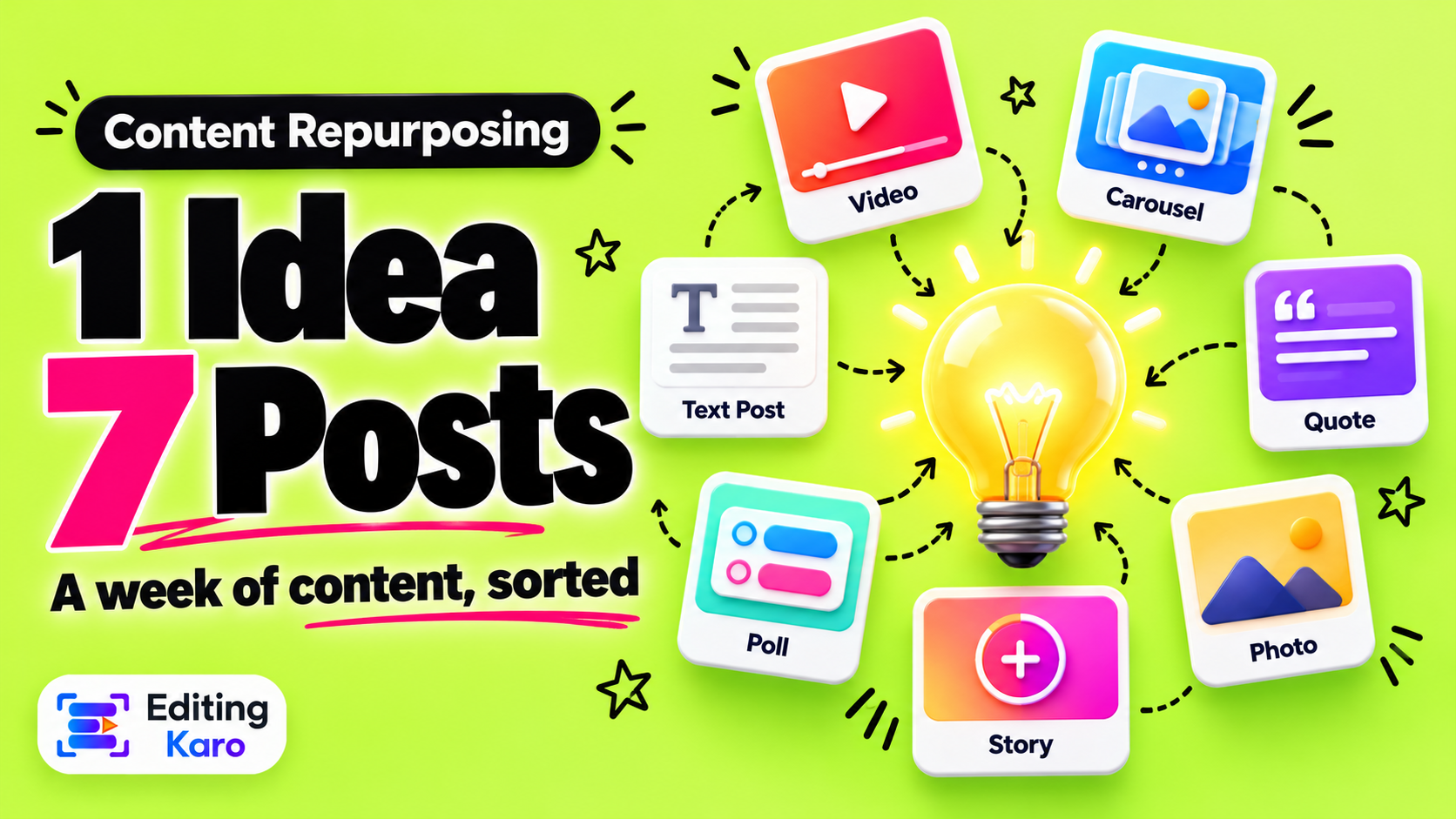
Content Repurposing: Turn One Idea into a Week of Posts
One Idea, Seven Posts: A Repurposing System for Creators and Small Teams
You don't need more ideas — you need to get more out of each one. A step-by-step system for turning a single idea into a week of content across Instagram, YouTube, LinkedIn, WhatsApp and email.
Ask anyone who runs a small brand's social media what the hardest part is, and it's rarely design or editing. It's the blank page. What do I post today?
Open all four studios free — no card, nothing to install.
The usual answer is to hunt for more ideas. That's backwards. Most small teams have plenty of ideas. What they do is use each one once — a single Reel on a Tuesday — and then start from zero on Wednesday.
Meanwhile the creator economy has turned into a volume game. Adobe's 2026 survey of Indian creators found the large majority now treat creative AI as a core part of their workflow (Adobe), and the people posting the most aren't thinking up five times more ideas. They're getting five times more out of each one.
Here's a system for doing that without your feed turning into copy-paste.
The principle: one idea, many shapes
Every platform wants a different shape:
Platform
Shape it rewards
Instagram Reels / YouTube Shorts
A fast hook, one point, under a minute
Instagram carousel
A step-by-step people save
LinkedIn
A lesson or story in text, professional angle
X
One sharp line, or a short thread
Stories / WhatsApp Status
Casual, behind-the-scenes, a question or poll
Email
A personal note with one clear link
Blog / YouTube long-form
The complete answer
The idea stays the same. The shape changes. That difference is why this isn't spam: someone who sees your Reel and later your carousel gets the idea reinforced in a new way, not the same file twice.
Step 1: Pick an idea worth a week
Not every thought deserves seven posts. A good pillar idea:
Answers a real question customers ask you
Has parts — steps, mistakes, examples, a before and after
Shows what you know that others don't
Stays true for months
Examples:
A baker: "Why your cake sinks in the middle — and four fixes."
A CA: "What a freelancer should keep ready before filing returns."
A boutique: "Five ways to style one plain white kurta."
A gym trainer: "The three-exercise routine for people who sit all day."
Step 2: Make the pillar piece
Create the fullest version first. Choose whichever is easiest for you:
Talk it through on camera for 5–8 minutes, or
Write it out as a detailed post of 500–800 words, or
Record yourself answering the question as if a customer had asked
Don't polish it. The pillar is raw material. What matters is that the complete thinking exists in one place: the hook, the points, the examples, the conclusion.
Step 3: Break it into parts
Go through the pillar and pull out:
1The main promise (one sentence)
2Each individual point (one sentence each)
3The best example or story
4A surprising fact or opinion
5A common mistake
6The takeaway
You now have a kit of parts. Each part can become a post on its own.
Step 4: Rebuild for each platform
Take the cake example — "Why your cake sinks in the middle, and four fixes" — through a week.
Monday — Reel / Short (the hook)
Open on a sunken cake. "Your cake sinks in the middle for one of four reasons." Run through them in 30 seconds with quick cuts. Export vertical at 1080 × 1920. Our Reels editing workflow covers the cut.
Tuesday — Carousel (the detail)
Eight slides: the promise, one slide per reason with its fix, a summary slide, and "Save this for your next bake." See the carousel design guide.
Wednesday — Stories / WhatsApp Status (the conversation)
A poll: "Has your cake ever sunk? 😅 Yes / Every time." Then a behind-the-scenes clip of you testing the oven temperature. Casual, no design needed.
Thursday — LinkedIn or Facebook text post (the story)
The angle changes: "In our first year we threw away one cake in five. Here's what we learned about consistency." Same knowledge, told as a business lesson.
Friday — Single-point Short (one part, deeper)
Take only reason number three — opening the oven door too early — and give it 20 seconds of its own.
Saturday — Quote or tip graphic (the takeaway)
One line on a clean background: "Don't open the oven for the first 20 minutes." Quick to make from a template.
Sunday — Email or broadcast (the personal note)
Three sentences, the four fixes as a list, a link to the Reel, and this week's menu.
That's seven pieces from one idea, and none of them is a copy of another.
Step 5: Change the opening every time
The most common repurposing mistake is reusing the same first line everywhere. The hook has to fit the place:
Reel: visual and immediate — show the problem.
Carousel: a headline with a number — "4 reasons your cake sinks."
LinkedIn: a personal admission or a lesson.
Email subject: curiosity, short — "The 20-minute rule."
WhatsApp: like a message to a friend.
Same idea, five openings. If you rewrite only one thing per platform, make it the first line. Our guide to captions people actually read has more on first lines.
Where AI helps — and where it doesn't
Repurposing is the job AI is genuinely well suited to, because the thinking is done. You aren't asking it to invent something; you're asking it to reshape something.
A workflow that works:
1Paste your pillar piece (or its transcript) into Content Studio.
2Pick the channel and format — an Instagram caption, a LinkedIn post, a YouTube description, an email, an ad.
3Set the tone and language, including Hinglish if that's how you talk to customers.
4Edit the draft. Add your own example, cut anything generic, and check every fact.
That last step isn't optional. An unedited AI draft sounds like everyone else's unedited AI draft. And as platforms push harder towards original work, your own stories and opinions are what keep the content yours. We've written about that shift in Instagram's originality rules.
Keep the look consistent
When one idea appears in seven places, a shared visual style ties it together and makes each piece faster to produce.
One template per format: carousel, quote, Reel cover, Story.
Same two fonts and brand colours throughout.
Resize, don't redesign. Build the design once and adapt it to 4:5, 9:16 and 16:9 in Pixel Studio. The free social media image sizes reference lists every dimension.
A weekly rhythm for one person
When
What
Time
Friday
Choose next week's idea; record or write the pillar
45 min
Saturday
Pull out the parts; draft all captions
45 min
Sunday
Edit the Reel and Short; design the carousel and graphic
90 min
Mon–Sun
Post one piece a day; reply to comments
10 min a day
About three hours of making, and a full week of posts. More importantly, you never open the app in the morning wondering what to post.
What not to do
Don't post the identical file everywhere with another app's watermark on it.
Don't stretch a thin idea. If the pillar has only one point, it's one post.
Don't publish all seven on the same day. Spread them out.
Don't skip the replies. Comments on Monday's Reel are often the best source for next week's idea.
Start this week
Pick one question a customer asked you recently. Answer it properly, once. Then use the table above to turn that answer into seven shapes.
Next week, do it again with a new question. After a month you'll have four deep ideas, twenty-eight posts and — the part that matters most — a reputation for knowing your subject.
Frequently asked questions
Is repurposing the same as reposting?
No. Reposting is putting the identical file everywhere. Repurposing reshapes the idea for each platform: a different hook, length, format and caption. Platforms and audiences both respond better to the second.
Won't my followers get bored seeing the same idea?
Very few people follow you on every platform, and most followers see only a fraction of what you post. Different formats also suit different people: some watch, some read, some save.
How many pieces can I get from one idea?
Comfortably five to ten. A single how-to can become a Reel, a carousel, a Short, a LinkedIn post, a Story sequence, a WhatsApp status, an email and a blog section.
Can I use AI to repurpose content?
Yes. It's one of the best uses for it, because the thinking is already done and the AI only changes the shape. Give it your original piece and ask for a specific format, then edit the draft so it sounds like you.
How often should a small business post?
Consistency beats volume. Three to five good posts a week from one well-developed idea will do more than daily posts made in a rush.
EK
About the author
Editing Karo Team
Designers, video editors and writers behind Editing Karo
We're the people who build Editing Karo's four studios — designers, video editors, writers and engineers based in Delhi. We spend our days making social posts, thumbnails, reels and captions, and watching what helps creators and small businesses get them out faster. Every guide here is written from that work: tested in our own tools, checked against each platform's current rules, and updated when those rules change.